
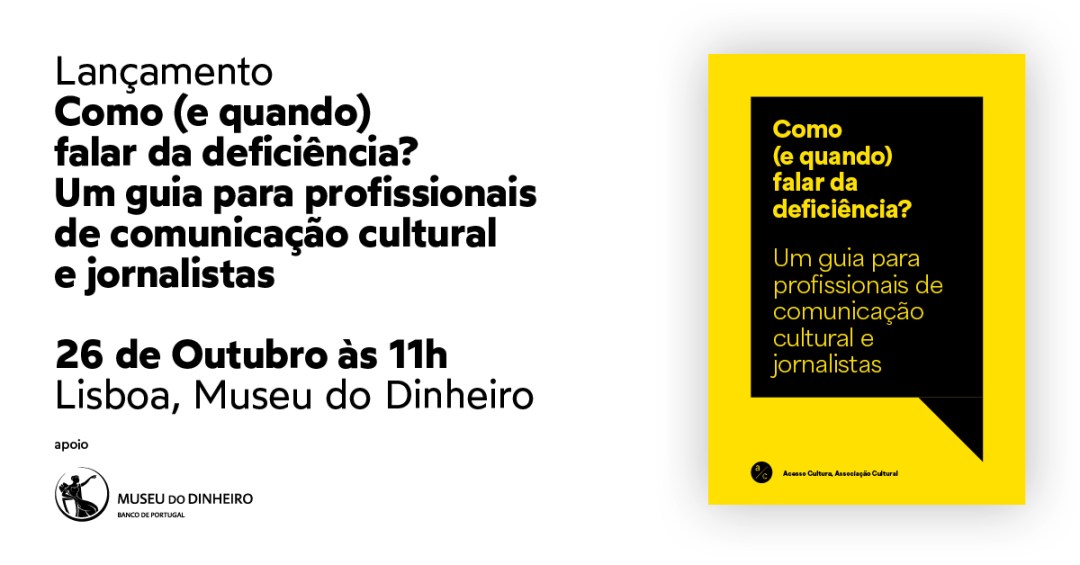
On October 26, at 11am, at the Money Museum in Lisbon, Acesso Cultura | Access Culture presents its new publication “How (and when) to talk about disability: a guide for cultural communication professionals and journalists”.
We are very aware that, at different times – due to our lack of knowledge and contact with certain realities – the cultural sector and the media sector have helped to perpetuate stereotypes in relation to people with disabilities and Deaf people, revealing ableist mentalities and attitudes. The public receives news with sensationalist titles, ableist references and incorrect terms.
Ableism is the word that defines discrimination, oppression and abuse against people with disabilities, considering them inferior to people without disabilities.
We consider it extremely important and urgent to address this problem, for the following reasons:
- Because we are very aware of the constant discomfort and inconvenience experienced and felt by colleagues, cultural professionals, who do not feel represented and end up feeling offended by the way their work and life stories are presented to society and the public;
- Because each person – and especially, in this case, communication professionals – has a responsibility to contribute to the creation of a society where everyone has the right to dream and be the best they can, without “labels”;
- Because, in Portugal, there is specific legislation and very relevant conventions have been signed on this matter. However, as we all know, people’s attitudes do not change by decree;
- Because it is urgent to break the ableist paradigm in the Portuguese society.
The guide was written by journalist Dora Alexandre (author of “Disability in the media: a guide to good practices for journalists”, 2012) and by the executive director of Acesso Cultura, Maria Vlachou. Six disabled or Deaf artists and activists were also invited to review and comment on the content. They are: Diana Niepce, Diana Santos, Joana Reais, Mia Meneses, Mickaella Dantas and Patrícia Carmo.
The focus of this publication is the area of culture, which is our area of work. We know, however, that what is presented here is also relevant for other areas, and we hope that it may also be useful to other professionals.
This publication is supported by Polo Cultural Gaivotas | Boavista of the Lisbon City Council. It will be available on our website, in Portuguese, on October 26.
 Access Culture