
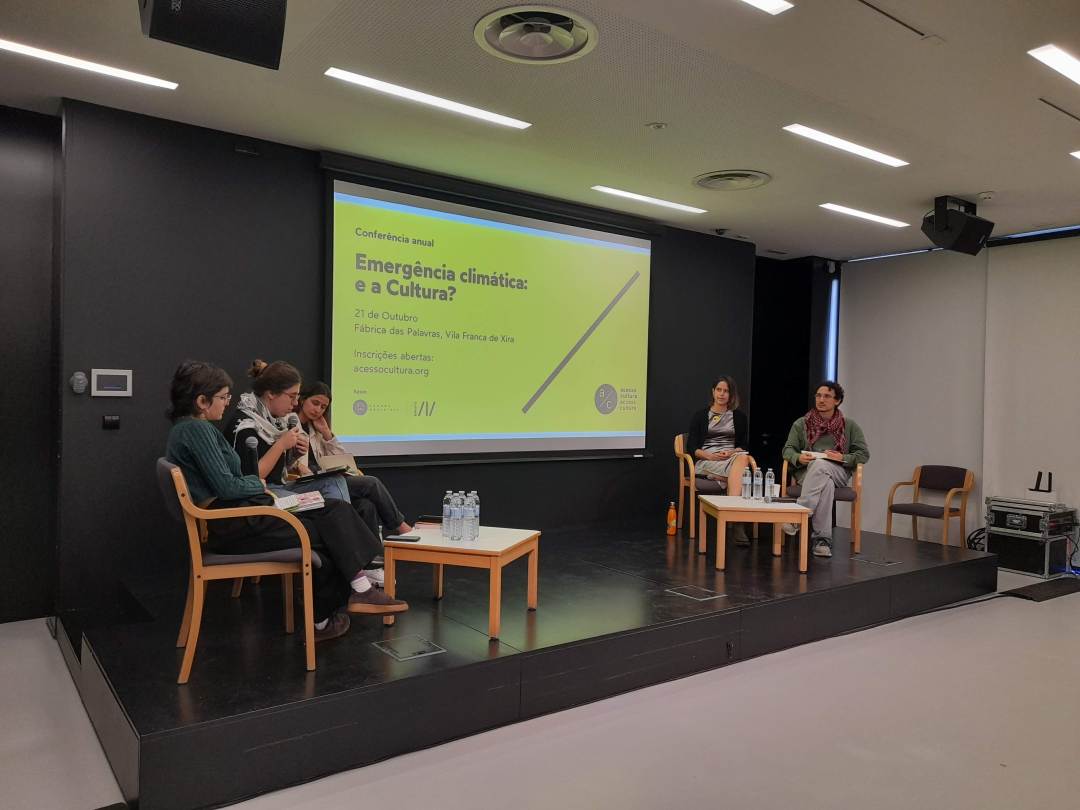
The poem read by Lua Eva Blue on October 21, 2024, at our annual conference, the theme of which this year was “Climate emergency: what about Culture?”
My name is Lua, I’m from Póvoa in this municipality, I have a degree in Art History, and at the moment I work as a gallery assistant in a museum. I deal with my anxieties and conflicts by making art, such as texts and poems, so I proposed to start the intervention of members of Climaximo with something I started writing in a quiet hour, while I was working and found out about the prison sentence given to five British activists – the Whole Truth Five group from Just Stop Oil – after a conservative journalist infiltrated a so-called civil disobedience call. I originally wrote it in English (because resistance groups ask for poems for the imprisoned activists, who are are now dozens of people):
Juxtapositions of an Activist-Worker mind
Forty hours a week in a museum,
telling visitors to be careful with the art pieces.
In moments of irony which doesn’t escape me,
I read about civil disobedience in the quiet hours;
and holding a book with my hands, partially concealing the title,
I tell the people I vigilate,
to not cross a black line, drawn on the floor.
Quietly sitting in the tall chair of the corridor, a Dali next to me,
I see news of more climate activists sentenced to prison.
And I ask myself if the visitors use art
as a momentary escape from a collapsing planet
or if art makes them passive towards this world.
And I say “Sorry, please mind the line”
(Where can the line be drawn in this duality?)
And I wonder how to be whole:
The quietness of these rooms makes this artist inspired,
this museum worker relieved,
this activist restless and uneasy.
Facing the juxtapositions of my mind,
I tunr and say “Sorry, please don’t touch”.
(Art has all these capabilities:
To protect, involve, to intervene, even entertain,
but it can also to domesticate you, and limit one’s potential,
leaving us limited to the mere acknowledgment of teh problem –
“look at this piece by this marginalized artist, you do your part by looking at it,
the structure that oppresses them is grateful if you merely feel compassion
you don’t need to attack anything”
– Oh, Art! Oh, Culture! Why is it that graduating in your History
taught me that I should think of you as you are
and not as artists and enthusiasts think of you?
Why is there propaganda
– including some from museological institutions –
which tells us that changing the world is something inherent to you?)
How many artists have died
How much material has been degraded
before we even start saying
“There’s no Art on a dead planet”
But Art, the pandora box that shook your world
was no artists’ death
and when it comes to material heritage:
it was no degradation due to temperature variation,
of freeze-thaw cycles or day-night thermoclastism,
or sea acidification, or defrost thawing,
The pandora box that shook your world,
Twas soup on glass and flour on stone.
So how can I say it didn’t work,
(And I didn’t want it to)
When I know of the conferences activists lead to?
When on my social circle, only did they start talking
When Van Gogh became a symbol of climate resistance.
I answer the visitors questions while I know
my friends are somewhere blocking a road
And I´m quietly protecting a Picasso
when my dearests are being detained in disobedience,
fighting against the actual biggest threat to our heritage.
There is a metaphorical lines
which I want everyone to cross
– it is located inside everyone’s mind;
you cross it when you answer to yourself:
Knowing what you know, what are you going to do?
There is still art on a dying planet.”
Eva Blue Moon
 Access Culture