
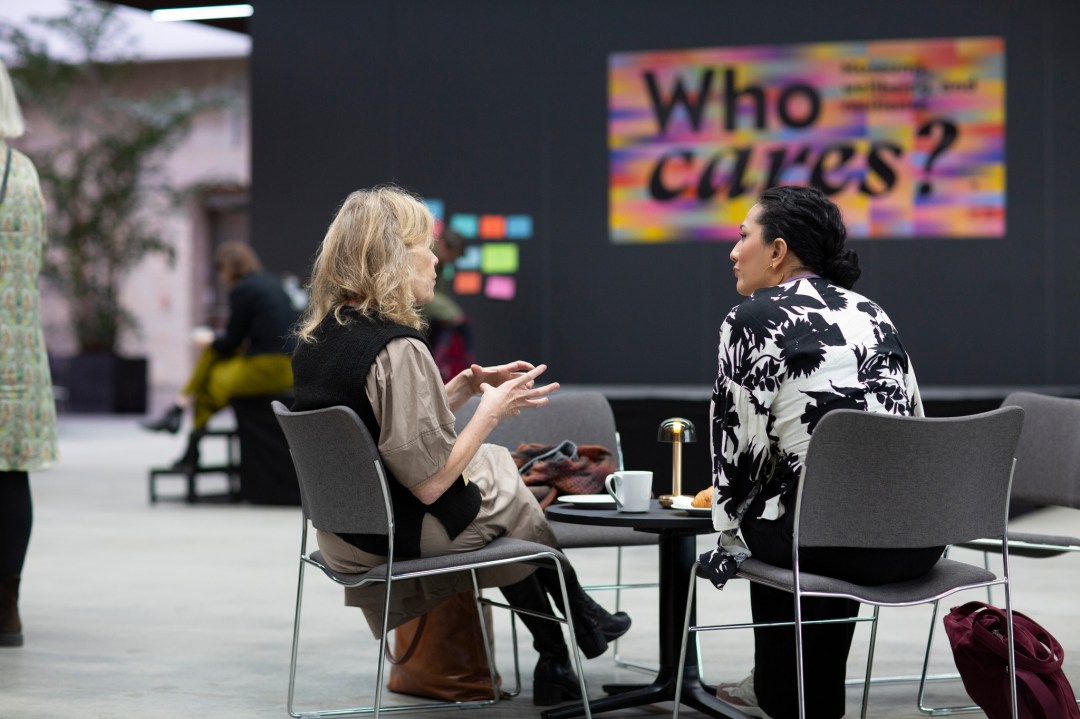
Denise Pollini, member of Acesso Cultura, received a grant in order to participate in the annual NEMO – Network of European Museum Organisations conference, which took place from 26 to 28 Ocotber 2025 in Horsens, Denmark. The theme was “Who cares? Museums, well-being and resilience”. Denise shares with us her reflections on what was discussed at the conference.
NEMO – Network of European Museum Organisations annual conference
“Who cares? Museums, wellbeing, and resilience.”
26-28 October 2025, Horsens, Denmark
“Though it might seem paradoxical,
it’s clear that making nothing leads to something,
and making something leads to nothing.”
Francis Alÿs
On the uselessness of museums
The Network of European Museum Organisations (NEMO) Conference, held in Horsens, Denmark, proved to be a valuable exercise in reaffirming my belief in the power of museums, though not for the conference’s explicit objectives, but rather for what, in my analysis, it failed to fully grasp: the possibility that museums may be essential in and of themselves.
Exceptionally well organised, the conference, entitled “Who Cares? Museums, Wellbeing, and Resilience”, began with a Forum restricted to NEMO affiliates in the afternoon of 26 October. Led by Secretary General Julia Pagel and the organisation’s executive members, this meeting served as an introduction to the conference’s central theme. According to Pagel, one of the reasons for choosing this theme was its contemporary relevance:
“You hear the topic of wellbeing and resilience come up once, twice, four times, 10 times, a hundred times, and we realize that we need some kind of central moment to bring these projects, the ideas, but also the many questions that come with it together. And this is why we decided to do the conference. And if I may add, of course, because we are a European organization and we see the same thing happening on European cultural policy level. So mental health and wellbeing is a strong topic at the moment, very visible at European levels.”[1]
The following day, which was open to the general public registered for the conference, featured Elizabeth Merritt (USA) as the keynote speaker. Merritt is Vice President for Strategic Foresight at the American Alliance of Museums and founder of the Center for the Future of Museums. Her keynote, entitled “Envisioning the Future of Health and Wellbeing,” presented her perspective on three principal future-oriented axes for museums:
(1) technology and data;
(2) human connection; and
(3) museums as a “new infrastructure of care.”
While the use of technology – particularly in its extension through data practices – deserves careful consideration, the focus of the present paper, in light of the conference theme, is to further reflect on what the participation of museums in a “new infrastructure of care” might entail. This reflection draws on Merritt’s remarks during an interview conducted by Claire Bown for the podcast “The Art Engager”, recorded shortly after her keynote address.
“We already have such a wealth of data that’s being presented at this conference about the well-known health benefits of being in the museum space. But what if that were personalized and got a little human assist so that you could go and say, I know that when I go to the museum, there´re gonna be people at the front desk to sell me a ticket, and there are going to be people helping me find my way. But there they’re also going to be the people there who are trained in mental health, who might be able to make most of my experience by giving me some one-on-one feedback.[2]”.
My primary concern relates to the question of what it would mean to be “trained in mental health.” In my view, mental health training requires formal education and closely supervised practice under the guidance of qualified instructors or mentors. This raises two further issues. First, are museums, as institutions, willing to support training of this scope and depth, particularly at a time when available data indicate increasing outsourcing and precaritisation of museum labour[3]? Second, what precisely would constitute this so-called “individualised feedback”?
Experiencing a psychotic crisis involving a visitor within an exhibition context is particularly revealing of the limitations surrounding the museum’s capacity – even under optimal conditions and with highly qualified mediation professionals – to function as a container for psychotherapeutic content. Such experiences underscore that the museum does not offer a therapeutic space, but rather a different kind of space altogether. It is precisely in this otherness, without the need for additional qualifying adjectives, that the value of museums resides. For this reason, each time the museum is compelled to justify itself through supplementary descriptors or arguments of an instrumental relevance, the specificity of the museum experience. is diminished rather than enhanced.
Funding for “museum prescritptions”
What became evident throughout the conference was the possibility that “museum prescriptions” might emerge as an additional source of funding for museums in a context of increasingly severe cuts to cultural financing. This perspective is articulated in the following excerpt from an interview with Julia Pagel:
“I think we have a great strategic advantage, and that is that we [Museums] are large cultural infrastructures across the globe. There is a museum almost everywhere, and that I think gives us an amazing advantage to really be close to where the people are, to where communities are, to where needs are emerging. But of course, that comes along with many challenges that we have to address and new profiles that the museum needs in order to be that place. And I think what we also have to have very clear is that we are at the prevention stage and making this prevention one of the say, cornerstones of what healthcare means nowadays. That can be translated into data and into money because it’s way less expensive to prevent from becoming ill, falling ill than to be ill, and then having to be cared for. So I think we, we really need to position ourselves in that preventive section.” (emphasis added by the author)[4].”
This logic is further reinforced when Merritt invokes the possibility that museums might “improve” a patient’s condition through “ten museum visits.” Later in the same interview, Merritt elaborates:
“Children already routinely go to museums for school trips where they learn about history or art history. They can be going to museums to learn about empathy and emotional response and self-regulation, social and emotional skills. These are things, museums know how to teach. And if schools thought of museums as a place to integrate that into their curriculum, that could be very powerful. One of the things I’ve been delighted to see at this conference is so many wonderful examples of prescriptions on demand for museums to be actually in the care system of doctors or healthcare providers, so that they would be saying, maybe you want to go to a museum. Here’s a prescription. One museum visit a week for the next 10 weeks and you will feel better.”[5]
In her article “Culture prescribed”, published in January 2024 on the blog Musing On Culture[6], cultural management and communication consultant and Executive Director of Acesso Cultura, Maria Vlachou, succinctly captures the conundrum that cultural prescription poses for museums and theatres in terms of outcome-based expectations: “If the patient does not improve, will the performance be to blame or will they increase the dose?”
The proposal to integrate museums into the healthcare system inevitably raises questions concerning the qualifications required to carry out actions in the field of mental health, whether in a clinical setting or within a museum. The debate surrounding so-called “lay analysis” can be traced back to Freud’s early disciples and gained particular prominence in 1926, following a complaint filed by a former patient of Theodor Reik-a psychoanalyst trained by Freud who did not hold a medical degree. Freud vigorously defended the right of so-called “lay analysts” and, in the same year, published “The Question of Lay Analysis: A Dialogue with an Impartial Interlocutor.[7]” In his defence of Reik, Freud asserted: “A charlatan is someone who undertakes a treatment without possessing the necessary knowledge and qualifications” (Roudinesco & Plon, 1997: 636). Thus, the core issue Freud addressed was not the practice of psychoanalysis by non-physicians – or by anyone whatsoever – but rather the question of what constitutes effective psychoanalytic training and a proper “preparation for the practice of psychoanalysis” (ibid.). In sum, by defending “lay analysis,” Freud reaffirmed the necessity of specific and rigorous training for the practice of psychoanalysis, which necessarily entails successive stages of education, mentorship by qualified analysts, and an intensive period of supervised clinical practice.
The relationship between art and psychotherapy has a long history, with Carl Gustav Jung representing a key theoretical reference. In Brazil, the psychiatrist Nise da Silveira (1905-1999) began integrating artistic practice into therapeutic contexts in the 1940s. In 1952, Silvera founded the Museum of Images from the Unconscious[8], which to this day preserves a collection of works produced by her patients-predominantly individuals diagnosed with schizophrenia—within the modelling and painting workshops established by the institution. It is important to emphasise, however, that within this historical trajectory artistic practice functioned as a means: a methodological tool for the expression of therapeutic and psychoanalytic content. Art, in this context, was therefore placed in the service of a clearly defined clinical purpose.
The “museum prescription” practices, by contrast, clearly offer museums new sources of funding, and in Portugal this issue already has a significant history. In 2014, the Portuguese government, in alignment with the cultural policy framework of the European Union, launched the programme “Parcerias para o Impacto” (Partnerships for Impact). Under this funding scheme, the government supported “the creation and growth of social innovation projects, promoting collaboration between the private sector and the social economy through co-financing with social investors, with the aim of addressing priority social problems in areas such as Digital Inclusion, Justice, Health, and Employment, with a focus on measurable outcomes and payment by results.[9]” A significant number of socially oriented cultural projects were supported during the programme’s first funding cycle. Among these, three projects in which I was involved-both in their initial design and in their implementation during the first year-may be highlighted: “Janelas para o Mundo” (Windows to the World), “Olhares Inclusivos” (Inclusive Gazes), and “Con(s)cienciarte”. Developed by the Serralves Foundation in Porto, these projects employed cultural mediation as a mechanism for social transformation and cultural inclusion. Respectively addressing the social issues of criminal recidivism within the prison system, the social exclusion of people with disabilities, and school failure and early school withdrawal, these initiatives collectively received government funding amounting to €547,243. All three projects required the extensive involvement of external entities responsible for measuring their social impact—a requirement that carried considerable weight both in the competitive evaluation phase and during project implementation.
It is highly commendable that close to half a million euros have been invested in initiatives addressing socialisation within the prison system, the social inclusion of people with disabilities, and the problem of early school abandonment. However, in projects such as these-and in many others supported under this funding scheme-the requirements related to impact mediation and measurement are so substantial, both in budgetary terms and in the obligation to design projects primarily around evaluative frameworks, that the order of priorities appears, in my view, to be inverted. The pressure to measure phenomena that are often, by their very nature, non-measurable—but which derive their richness precisely from exceeding what can be captured in an Excel spreadsheet-exerts an excessive influence on project design. This, in turn, may ultimately compromise the very transformative potential such projects seek to achieve.
The cultural sociologist Pascal Gielen offers an important reflection on this issue at the level of European cultural programmes in his text “Culturing Commoning Culture. Creative Europe: 0.14% for Democracy.[10]” There, Gielen observes that between 2014 and 2020 only 0.14% of the European budget was allocated to culture (Ciancio 2020), and that of this amount, between 10% and 20% was spent on documentation, reporting, and legitimisation processes.
According to the Houaiss Dictionary of the Portuguese Language, “prescription” is defined as the “act or effect of prescribing (to establish, order, or formally indicate something), an order, a precept, a medical prescription, and, in legal terms, the extinction of a right or penalty.” The etymology of the term derives from the Latin praescribere-with prae- indicating “before” and scribere meaning “to write”- referring to a prior inscription or order in Roman law.
The notion of prescription therefore presupposes a result to be achieved as the outcome of an action initiated by the prescription itself. As a museum educator with more than twenty years of professional experience, and as someone deeply concerned with the problem of “neoliberal museums,” I argue that museums should move in the opposite direction of continuously adapting themselves—down to the last clause-to market—driven evaluative logics. Instead, they should critically question the very frameworks of prescription and outcome-based assessment that operate on the premise of predefined results, at the risk of undermining their own institutional and experiential potential.
In this context, the words of the Belgian artist Francis Alÿs repeatedly return to mind, almost as a premonition. Museums constitute one of the few spaces in which “doing nothing leads to something.” It is precisely this “something”—which cannot be measured in advance—that is increasingly lost each time the museum is instrumentalised as a pathway or tool for objectives other than the museum experience itself.
[1]https://podcast.artengager.com/episode/who-cares-museums-wellbeing-and-resilience 03´42´´ accessed on: 13/11/2025.
[2] https://podcast.artengager.com/episode/who-cares-museums-wellbeing-and-resilience 00´10“ accessed on: 13/11/2025.
[3] As I was completing this text, I was confronted with the following news item: “At the Louvre, staff unanimously vote for strike; the museum will close as of Monday morning,” published in Le Monde on 15 December 2025. The subheading further specifies: “Meeting in a general assembly on Monday, staff members of the Parisian museum voted, according to the CGT and CFDT unions, in favour of a ‘renewable strike’ to protest against the ‘deterioration’ of their working conditions.” https://www.lemonde.fr/culture/article/2025/12/15/au-louvre-la-greve-votee-a-l-unanimite-par-les-salaries-le-musee-ferme-a-partir-de-ce-lundi-matin_6657590_3247.html
[4]https://podcast.artengager.com/episode/who-cares-museums-wellbeing-and-resilience 05´06´´ accessed on: 13/12/2025
[5] https://podcast.artengager.com/episode/who-cares-museums-wellbeing-and-resilience 03´42´´ accessed on: 13/11/2025. 00´12´
[6] https://musingonculture-en.blogspot.com/2024/01/culture-prescribed.html
[7] Freud, Sigmund. (1964). The Question of Lay Analysis: Conversations with an Impartial Person. Anchor Books.
[8] https://museuimagensdoinconsciente.org.br/en/ accessed on: 13/12/2025
[9] https://inovacaosocial.portugal2020.pt/financiamento/parcerias-para-o-impacto/
[10] In De Tulio, M. F. (Ed.). (2020). Commons: Between dreams and reality. Creative Industry Kosice.
References
Ciancio, Guiliana. 2020. “Between cultural participation, trust and policy perspectives: the case of the Creative Europe programme Experimenting success and failures of co-imaginative politics”. In Cultural Policies In Europe: a Participatory Turn? Edited by F. Dupin-Meynard, L. Bonet, G. Calvano, L. Carnelli, E. Négrier & E. Zuliani. Toulouse: Les Editions de l’Attribut.
De Tulio, M. F. (Ed.). (2020). Commons: Between dreams and reality. Creative Industry Kosice.
Freud, Sigmund (2014) Obras Completas, Freud (1926–1929) – O futuro de uma ilusão e outros textos, Companhia das Letras, São Paulo, 2014.
Gielen, Pascal (2020). “Culturing Commoning Culture. Creative Europe: 0.14% for Democracy” in, De Tulio, M. F. (Ed.). (2020). Commons: Between dreams and reality. Creative Industry Kosice.
Roudinesco & Plon (1997). Dicionário de Psicanálise. Jorge Zahar.
Vlachou, Maria. “Cultura prescrita.” Em “Musing on Culture”, 3 de janeiro de 2024. https://musingonculture-en.blogspot.com/2024/01/culture-prescribed.html
 Access Culture